
Head and Heart
Humanity's Struggle Against Reason

Let’s start with words by French writer, poet, and aviator, Antoine de Saint-Exupéry, written in his book, The Little Prince, 1943:
“It is only with the heart that one can see rightly; what is essential is invisible to the eye.”
The Book’s Idea: The Little Prince is about a young, otherworldly prince who travels from planet to planet, meeting a series of characters, each representing different human traits and flaws. Through his encounters, the Little Prince explores themes of love, loneliness, responsibility, and the search for meaning. It emphasises that true understanding, deep appreciation, and meaningful human cognitive connections come from emotional insight (emotional intelligence) rather than mere physical sight (quantifiable evidence).
The Author: Before becoming famous for his literature, Antoine worked as a commercial pilot and flew reconnaissance missions during World War II. His experiences as a pilot, mainly solitary flights across deserts and oceans, deeply shaped his reflective and humanistic writing. He had to use his intellect to fly the plane, yet his heart led him to make sense of his journeys.
As we reflect on Antoine and his journey towards the invention of “The Little Prince”, I want to bring attention to how much Antoine’s silent, reflective periods mattered to orient his head and his heart. That story has had a profound philosophical effect on human beings all around the world, regardless of culture, religion, background, identity, or circumstance. Its impact illustrates the interconnectedness between all humans in its deepest sense.
Social noise and millions of ideas are simply distractions when they are heard without time to connect to the consciousness that can process them. Antoine spent hours with his head and his heart alone, looking at the world below from up above.
HEAD AND HEART
Humanities Struggle Against Reason
This piece is about the human heart and its power.
I will look at recent events in America as a lens for the struggle between head and heart (aka reason and emotion).
The human heart needs to feel right; until it does, it cannot be quieted.
I am far away, nowhere near U.S soil, and usually I protect my mind from the constant bombardment of terrible news, divided America, and the media’s self-serving constructions of reality, but this week I cannot look away.
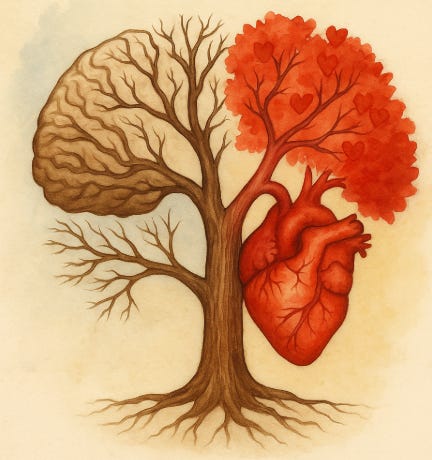
America is falling apart at its systemic seams. Its heart is broken, and its head hurts.
People do not know how to feel about any of it or what to do.
It is hard to continue speaking with reason as opposed to just choosing instead to sit and stare at the horizon, and just lean into the feeling.
To name a few of the back-to-back events which have pulled at America’s heart and silenced its reason, are the political assassinations of Melissa Hortman and her husband Mark Hortman in their home on June 14, 2025; the stabbing of Ukrainian refugee Iryna Zarutska on August 22, 2025, by a man with a long criminal and mental health history; the political assassination of Charlie Kirk, shot and killed just a few days ago on September 10, 2025, while speaking at Utah Valley University; and another school shooting at Evergreen High School, Colorado, on the same day, yet another shocking, painful addition to the unimaginable string of weekly school shootings thanks to America’s peculiar (and politicised) relationship with guns.
Why should the world care about America?
Well, first, it’s in most of our feeds, which means it’s in most of our minds. So, we need to make sense of its culture since it forcibly bleeds into all of our lives. For a long time, America, or at least its progressive Western values, has been regarded as a beacon of hope toward the intellectual benefits of free speech, open expression, and human rights. These are often seen as important values on which the advancement of modern civilisation depends. Many neighbouring countries have, sometimes unconsciously, adopted these ideals because they promise the freedoms and opportunities that underpin a more open society. Collectively, we hoped that it would help us be seen with more individuality and to treat one another better, and to live more civil lives.
**Research in sociology and public health shows that when societies grow more individualised, that is, less community-oriented, rates of loneliness, anxiety, and political polarisation start to rise, while trust and civic engagement decline.
Usually, I choose not to write opinionated pieces about politics, as it easily inflames division and is not conducive to the balance of thought humans are capable of. But this week, it feels wrong to write a letter without bringing attention to and paying respect to those who have lost their lives as a result of this crazy cultural war, as well as what people are desperately trying to make sense of.
Bad things happen everywhere in the world, and we must not ever forget that we usually and unreasonably care mostly about what we see more often, since it evokes feelings. But recently, a string of major events has shaken those who once trusted in what were long seen as the guiding ideals of the West, and many are unwilling to accept that this might be the path we are now taking.
So, people are asking where to go from here. Up? Down? Back?
Social tensions are at an all-time high.
The human heart does not often sit quietly in times like these. In these times, our intellectual mind struggles to find a place at the front. When things no longer seem fair or rational or reasonable, our raw primal human instinct takes over, and we become mad, angry, upset, unfair, irrational, and sometimes unreasonably violent.
We react based on how we feel, and we cannot think clearly.
It is a shame because, with wider access to science and education, we have been realising our human capacity for intelligence and civil conduct, drawing on logic, reason, and emotional intelligence. We have been slowly refining the way we speak and think: to try to be tolerant, fair, flexible, coherent, brave, factual, aware, and to consciously cultivate all the cognitive traits that deepen our connections with one another in our path to understanding the logic behind human diversity and ideas.
Despite all that, we observe, our intellect and reason can be thrown out in a flash.
Except maybe this is what it’s all about. Just like Antoine tried to illustrate as he wrote The Little Prince, that for humans, matters of the heart can never be intellectualised, no matter how hard we try. The human spirit is far too entrenched in a deep, unexplainable need to be oriented by the heart, and so the heart must find its place in the world. If we do not do this, and we risk allowing the wounded heart to guide us, then we are instead making choices driven by pain and resentment rather than by clear judgement.
How do we rationalise to heal our hearts and understand what is happening in America?
When I think about why this is happening to America, and try to rationalise it intellectually, I can see the long chain of events in the system of things that might have brought it here.
If we go back to the rise of free speech as a democratic ideal, to the right of anyone to stand for political office, democratic freedom seems to have been the best thing we have had to enable every voice to have the opportunity to be heard. Layered over this is the country’s unresolved history of slavery and segregation. This is all calculatedly inflamed by the tight grip of media and political campaigns that keep these wounds raw and fuel partisan divisions just to predict the same voting patterns. At the same time, the rising tide of Western mental health struggles, driven by an epidemic of loneliness, and that issue is colliding head-on with the widespread availability of firearms.
When the mind is in chaos, psychological turmoil erodes rational thought.
It is important to know that social and major media popularise ideologies that serve political campaigns and economic gain; they are not there to deepen public understanding and nurture intellect. Their motivations are to provoke strong emotion so that the intellectual mind is suppressed. It is a proven evidence-based psychological marketing strategy for mammoth economic gain. They are smart, and they are greedy. So here, the powerful and rich and clever use calculated headwork and intelligence to agitate the hearts of ordinary people. And people really get agitated.
People just cannot see this because the pull of the heart is so powerful.
All of this brings attention to when our outside worlds are not aligning with the needs of our inner world. When this happens, we are less likely to be rational and reasonable or use critical thought.
The same freedom that has allowed us equally to feel we have a right to be seen and heard also has had the capacity to become a mental monster.
We have not been taught how to pause long enough for clear thought to catch up with raw feeling, so our reactions begin to define us more than our reasoning.
To watch America drift towards a culture that cannot tolerate dissent is unsettling. Only because there are probably so many more terrible acts to come before this will end.
So, what do we need?
This far into my work, where I think a lot about how we behave socially and why we do these things, we need to really think about in what conditions we perform best as well as the worst.
So far, in my view, the most reasonable, fair, and influential people share a pattern. They use critical thinking to decide which information is worth turning into applied knowledge. At the same time, their respect for critical thinking and ability to apply intelligence makes them aware of the need to build emotional self-awareness, which in turn strengthens emotional intelligence. Critical thinking helps them make intelligent decisions; emotional intelligence helps them work with people intelligently. All of this aids in strengthening their social intelligence (the clarity in how they see social facts connect). They see more clearly because they use multiple intelligences to view the world with a little more objectivity than usual.
In my eyes, the real modern-day culprit is the intolerance for disagreement.
An intelligent civilisation sees differences of opinion as disagreements that require fair debate and discussion; an unintelligent or at least very unhelpful and socially unfruitful approach is responding to differences in opinion as if they were a biological threat.
We have begun to pressure others to validate us not through the strength of our character, the fairness and human logic in our words, or the ethical substance of our social achievements, but simply by forced acceptace of us, as we are, the way we are, even when what we do is seen as wrong, unjust, lazy, careless, selfish, or unfair to others who have an equal right to be heard.
As a culture, when someone resists our ideas, we take it personally because we have tied our identity to those ideas. And human beings are deeply in desperate need to have an identity and to feel belonging. We are deeply social, hence the need for an outward identity, and that is tied intrinsically to our basic biological needs to be accepted and included somewhere.
The rising and multiple social identities we have created seem to be deeply problematic socially for us as a collective, united, and peaceful citizens, because there are too many people with too many ideas, and all are intolerant of other ideas. We are simply pitting one identity against another, group against group, person against person, and so everyone is in disagreement all the time.
When our social position (or identity) is challenged, even in words, we do not like it, and we take that as a personal threat to who we are. And since we value ourselves so much more than anything else, we have become intolerant of disagreement. We view disagreement as a rejection of us, as opposed to realising the profound intellectual opportunity to think more about why the resistance exists in the first place.
This is bad.
In short, we need our ideas to be challenged if we are to think.
If you want your intelligence to mature, you must accept that there will be people who trigger you emotionally, but this strange, primal discomfort will give you the opportunity to reflect and consider what is happening intellectually.
And we need not resort to killing or violence when we hear words we do not like.
Whatever happened to the lesson we teach our children, almost universally dear adults? “Sticks and stones may break my bones, but words will never hurt me.”
The words are not literally true; words can, of course, hurt our feelings, but it is a cultural shorthand for the importance of emotional resilience.
We need emotional intelligence to be able to know when to activate critical thinking for human problems. The Western world, with its celebration of equal speech, has become almost drunk on the desire to be heard, everyone speaking at once, each believing their voice carries greater moral weight than another’s. When we turn values into political weapons, we risk stopping the very thinking those values require.
I don’t have to agree with everything people say—and I don’t. Do I have strong opinions? Of course. Do you? Of course you do. I’m often irritated, annoyed, even enraged or unsettled by some ideas. I also fantasise about deleting people from my life permanently, and sometimes I do (after thinking about it). But despite my feelings, I know intellectually that those voices must exist if civilisation and our collective intelligence are to prevail. I need them to provoke me emotionally so that my intellect is forced to step in and make sense of what is being said.
Without that kind of provocation, we will not think.
And if a person is only using words, I know that friction is not a physical and biological threat; my intellect tells me that, and I dust myself off and prepare to face another day of potential interaction with idiots.
We need people who will challenge our ideas and offer different points of view to keep our minds working. When we no longer respect the value and need for our thinking to be tested, we stop being forced to think.
In America, emotions have been given such a dominant front seat that reason is now often left behind. The heart is not the enemy, and emotions are not either. They are the differences that make us human, and they guide us toward compassion and justice, and empathy. But we need emotional intelligence to understand the ways of the heart, and we need our human intellect to even reach that sort of sophisticated understanding about human cultural complexity.
Final Thoughts
History suggests that societies eventually rediscover a balance. During the Great Depression, the poet Carl Sandburg captured human resilience when he wrote in The People, Yes (1936):
“The people will live on. The learning and blundering people will live on. They will be tricked and sold and again sold and go back to the nourishing earth for rootholds.”
I do not think Sandburg was being naïve or primitive. He knew people could be deceived and divided, but he also believed that after turmoil, they return to what steadies them, that is, community, shared values, the grounding “rootholds” that make clear thinking possible again. It is that capacity to recover our footing, to let the heart feel, and then call the head back into the conversation.
Many non-Western societies thrive on shared and collective values today, and despite life’s hardships, they return at the end of the day to homes where hearts try to unite and the intellect is put away for the evening. The West has often viewed this as backward, primitive, or dismissive of important intellect, and yes, to an extent that can be true, but it still gives us much to consider about how we balance matters of the heart and matters of the head. If we do not continue to fight for that internal balance, I am afraid we will all end up feeling like America does today.
Thanks for reading my thoughts.
Today, I have no activities or links for more services or recommended books. It just feels wrong. Just sit in now and think about what and who heals your heart and where in the world you are when everything feels exactly right. Go there today.
From my heart and mind to yours,
Esha.
Esha, thank you for today’s column. I REALLY needed to read this. I am in the USA and it is very stressful here now. I wish everyone here would read your words of wisdom. Most here would simply not take the time. Thank you again, you made my day better.
Esha, that is an unbelievably apt and well argued super piece of work. Every single word and sentence hit me with its truth in both a personal and macro level. It made me think about a recent upsetting conversation with a person outside of my usual circle. Thank you.
Thank you also for accepting my feelings toward current events in the west. I envy your brilliant insight.
With kind regards
Jenny from WA Australia. ❤️