
The Self Vs. Society
Have you figured out what constructs your reality?

Welcome to today’s Sunday Synapse and The Trio of Thoughts:
THOUGHT 1: A QUOTE FOR REFLECTION
“Human existence is, ab initio, an ongoing externalization. As man [sic] externalizes himself, he constructs the world into which he externalizes himself.” — Peter L. Berger & Thomas Luckmann’s The Social Construction of Reality: A Treatise in the Sociology.
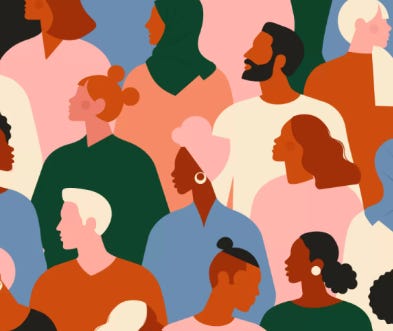
THOUGHT 2: THE SELF VS. SOCIETY
The self is often in conflict with society. I have yet to meet someone who tells me everything feels right, always and forever.
It could be an immediate environment (home, intimate relationships), a community (church, family network, hospitals, sports centre), or a larger social environment (country, government precincts).
In my work with people, I often look at where the self sits deep down, and what it takes to bring it out again. What can we do to help us rise, and what pushes us back down?
Watch these patterns and how they connect; this is logical intelligence. Notice how we feel or how others feel and their connections; this is emotional intelligence.
When I began training as a social scientist, I was introduced to a way of thinking called social constructionism. Then, I taught it and wrote about it scientifically for years and years. Keeping such a sharp focus on this ONE idea has led me to some of my best critical thinking, as well as taming my problematic intuition.
It is simply one of the many brilliant approaches for thinking critically (and specifically sociologically) about society. What it allows us to do is ask which aspects of society are socially constructed—that is, formed through repeated behaviours and everyday practices in our environments. This can include the way schools operate and teach, the ideologies and values our parents and communities raised us with, the behaviours permitted at work, the influences on how we think, such as priorities set by governments, and, very importantly to our modern lives, the media we consume most of the time. These repetitions turn into social habits, and as humans, we absorb them unconsciously. Over time, they shape what we think are our own thoughts and our own behaviours.
What matters here is that these “social norms” can also distort our sense of reality.
I think this is a crucial conversation in today’s information climate, where people are often arguing intuitively rather than critiquing intellectually the reasons behind human behaviour. Critical thinking gives us the ability to pause and use our intellectual minds to assess the evidence available to us. As a species, we know we are capable of higher reasoning, and we do not have to rely solely on primal intuition or emotional impulse.
This was groundbreaking for me, because when I applied critical thinking in this way to my environment, I could use my intellectual mind to analyse which factors might be socially constructed. It helped me see how much of society and our social interactions determine what is considered “thinkable.”
When will we think about it?
For example, unless something is seen as socially necessary, we won’t think about it! You can see this everywhere—people only engage with certain ideas if they recognise some worth in doing so. Most, however, will avoid activating the intellectual (critical thinking) mind around a topic once they’ve already decided what they believe, preferring to hold on to that “truth” as it is.
Social constructionism can be intellectually liberating, but like any framework of thought, it can also become limiting depending on the depth of self-awareness of those who use it and their conscious motivations.
It is most definitely not the only valid way to think. It is just one framework—useful for identifying what is socially constructed, and by contrast, what is not.
The problem is that today it is often co-opted politically and by the media, because it is both politically popular and it is easy to trigger people emotionally, and it helps make a lot of money. Using it drives powerful social and political campaigns as it convinces people that society and other people alone are always to blame, rather than encouraging us intellectually to also look at the full spectrum of the self as well as society. As a political move, it is masterful! But the result is that our collective intellect has been thrown into a kind of madhouse.
Just as a reminder: if any of us go to a therapist to sort out our lives, a good therapist will help us analyse our world and understand how our past has shaped our perceptions—so we can reduce anxiety and stop placing all the blame outside ourselves. A bad therapist, on the other hand, will have us walking out angry at the world. And that makes no sense for psycho-emotional health and well-being.
So what might help?
We need to start learning how to use our brains intellectually as a basic standard. As a collective, we have not yet entered the era where governments, societies, and communities advocate for shared intellectual life. We are still shaped by the old obedience model of the industrial age. But in this new age of information, we have the chance to raise our collective intellect and consciousness. But we cannot rely on intuition until we first use intellect to recognise how it also tries to disorient us. Once we know this, then we use that same intellect to orient it, so that our intuition becomes something we can trust.
For those who want to use social constructionism for personal benefit, it should be seen as a clear and powerful tool to apply critical thinking to themselves, people, and society. You can use it to analyse yourself, your thoughts, your home, the people in it, your workplace, colleagues, and the wider society and those who shape it. Here, though I need to warn you to be careful, analysis paralysis and the Dunning-Kruger effect are real. Don’t turn critical thinking into a form of aggressive criticism, which we are seeing a lot of people doing right now. The way to avoid this is by using curiosity as the driver to learn to understand.
In doing this, you can begin to separate the things that are possible to change, the things that are harder to change, and the things that are essentially fixed. What becomes clearer is the difference between what is socially constructed (patterns and norms that can be unlearned or reshaped), what is psychological (habits of mind and neurological wiring that are more difficult—but not impossible—to rewire), and what is biological (the fundamental structures of the body and brain that are, for the most part, fixed).
Why should we bother?
The reason this matters is that much of what we struggle with as people comes from a major mismatch between the social realities we live in (or have lived in) and the psychological, emotional, biological, or spiritual needs that go unmet. I am convinced this is the source of most of our problems—everything else is just noise.
If you are living a social life that feels like a good fit for your mental health, happiness, and overall well-being, but you still find yourself easily triggered or frustrated by others in ways that spoil your days, it may be worth reflecting on which personality tendencies or behavioural patterns are contributing to this.
Psychology teaches us that while core personality traits remain relatively stable, our responses and coping strategies can be reshaped over time. Neuroscience teaches us that our brain wiring is difficult, though not impossible, to reconfigure with sustained effort. Sociology teaches us that we are not only shaped by environments but also to think about our capability of reshaping them by adjusting our social settings, relationships, and daily practices. We can create conditions that support the best in us. The latter can help with coping and then neurological rewiring over time.
Finally, figuring out which factors in our social world are socially constructed is a private, lifelong personal task. As you do this, you will begin to slowly uncover who you are at the core. Remember, the point of social constructionism is not to tear down all the social norms that have been shaping you and be left with bitter and resentful attitudes. It is to understand how they shape you, to see which ones can stay because they align with who you are, and which ones need to change, or are doing you a disservice. It is about testing, reflecting, adjusting, and adapting.
Once you strip away the ones that no longer serve you and “find yourself,” the next part begins.
You need to decide what you, at your core, want to do with this cognitive freedom. You can now construct your life into anything, so what will it be, and what principles will guide the choices you make in reconstructing your world to reflect what you truly want?
THOUGHT 3: ACTIVITY
Think about what lies at your core. This isn’t easy, and it may not be immediately evident, since you’ve spent a lifetime participating in social experiences and absorbing externalised ideas that cloud your sense of self. But look for patterns.
When do you feel most at ease?
Where do you feel most at ease?
What sorts of people are there? What are they like, and what do they talk about?
What gives you a sense of calm, belonging, and comfort?
What are you drawn back to, and what do you try to stay away from—and why?
Academic References
Berger, P. L., & Luckmann, T. (1966). The social construction of reality: A treatise in the sociology of knowledge. Garden City, NY: Anchor Books.
Kolb, B., & Gibb, R. (2011). Brain plasticity and behaviour in the developing brain. Journal of the Canadian Academy of Child and Adolescent Psychiatry, 20(4), 265–276.
Non-Academic but Evidence-Based Reads
Haidt, J. (2012). The righteous mind: Why good people are divided by politics and religion. New York, NY: Vintage Books.
The ideas in this book connect with this week’s article’s themes of social construction + neuroscience + psychology, but readable for a wide audience. It’s engaging and gets at that core tension of the self in conflict with society, intuition vs. intellect.
MORE PRODUCTS AND SERVICES
For More Products and Services Click Here: https://stan.store/dreshalovric
Please know that I do all of this public work for free and in my own time. I do this while trying to work to make money for a living, so I can not offer all of my work for free. Some of my services are paid. However, I promise you I will never place my regular Sunday Synapse Newsletter under subscription or behind a paywall. It will always be free. I share all of what I think there. I am also around in the comments to have chats when I can. Get in touch if you want to explore a new idea or if you have any type of proposal for me. All ideas welcome!
Contact me at:
info@dreshalovric.com
Thank you for being here with me. I am so grateful to you all.